SCADA Systems
SCADA Systems
What are SCADA Systems?
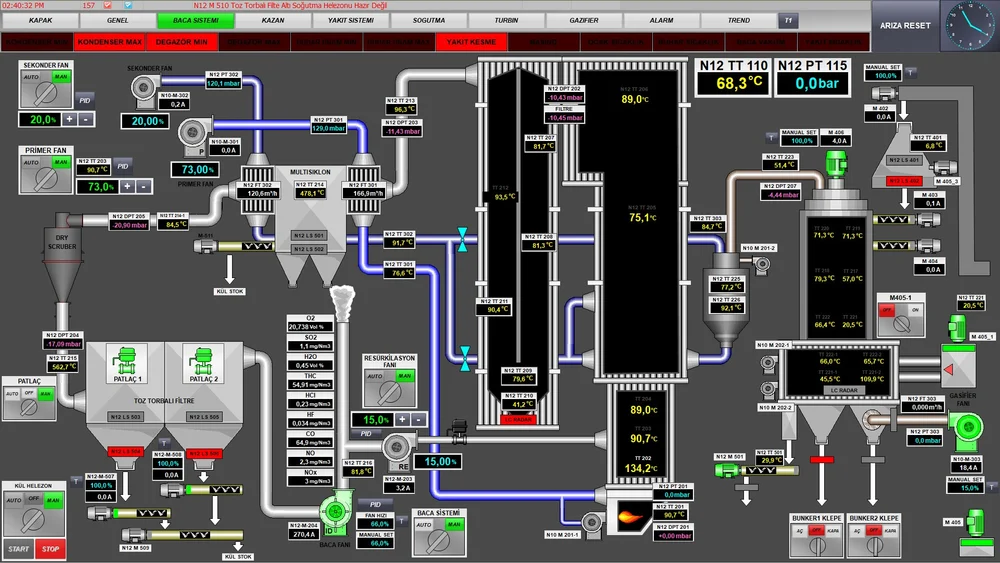
SCADA (Supervisory Control and Data Acquisition) translates to "Supervisory Control and Data Acquisition System" in English. It is a system that provides real-time data monitoring, control, and automation in industrial plants, power distribution, water management, and large-scale production lines.
Key Features of SCADA Systems
Real-Time Data Acquisition
Collects data instantly from sensors, PLCs, and other devices.
Monitors parameters such as temperature, pressure, flow rate, and energy consumption.
Remote Control and Process Management
Operators can manage systems from a central control room or mobile devices.
Commands such as opening valves or stopping motors can be issued.
Data Visualization (HMI Interface)
Presents data through user-friendly graphics via HMI (Human-Machine Interface) screens.
Facilitates operation with process diagrams, alarm panels, and trend graphs.
Historical Data Recording and Reporting
Stores collected data in databases.
Used for performance analysis, energy efficiency reports, and quality control.
Alarm Management and Fault Detection
Generates automatic alarms when critical values are exceeded (e.g., overheating).
Can alert operators via SMS/email in case of failures.
Industrial Network Integration
Communicates with devices such as PLCs, RTUs (Remote Terminal Units), and DCS.
Supports industrial protocols like Ethernet, Modbus, Profibus, and OPC.
SCADA Applications
✔ Energy Sector: Electrical distribution networks, wind/solar power plants.
✔ Water and Wastewater Management: Treatment plants, pumping stations.
✔ Oil & Gas: Pipelines, refinery control systems.
✔ Manufacturing Industry: Automotive, food, pharmaceutical factories.
✔ Building Automation: Smart building systems, HVAC control.
Advantages of SCADA Systems
✅ Centralized Control: Unified management of the entire facility.
✅ Increased Efficiency: Optimization through real-time data analysis.
✅ Rapid Response: Immediate alerts to operators in case of failures.
✅ Cost Savings: Improved energy and labor efficiency.
✅ Long-Term Data Analysis: Process improvements based on historical data.

SCADA vs PLC: Key Differences
Feature | SCADA | PLC |
Primary Function | Data collection, monitoring, reporting | Field device control |
Application Scope | Large-scale facilities | Individual machines/production lines |
Software Structure | Graphical interface (HMI) and database | Programming in Ladder Logic, ST, FBD |
Connectivity | Communicates with multiple PLCs/RTUs | Direct connection to sensors and actuators |
SCADA acts as the "brain" of a factory, while PLCs manage physical operations like "arms and legs."
The Future of SCADA (Industry 4.0 & IoT)
• Cloud-Based SCADA: Remote data storage and access.
• AI Integration: Anomaly detection and predictive maintenance.
• Cybersecurity: Protection against hacker attacks on industrial networks.
Conclusion
SCADA systems are indispensable technology for the "smart" management of large-scale industrial plants. Through data-driven decision-making, remote control, and automation, they enhance efficiency, safety, and quality.
Our company designs and implements SCADA systems from scratch, as well as customized solutions for existing systems.
Features of Our SCADA Systems:
• Online monitoring and remote intervention options.
• User security levels with individual permissions.
• Historical data recording with customizable reporting.
• Report visualization in graphs, data tables, and other standard formats.
• Accessibility via PC, laptop, Android, or iOS devices.